

Why Tracking Your Progress Matters
If you are trying to lose weight, it is tempting to judge your entire journey by one number on the bathroom scales.
That’s understandable.
The scales give you an obvious measurement.
But they don’t tell you everything.
Your body weight can change from day to day because of water, food in your digestive system, salt intake, carbohydrate intake and other normal fluctuations.
You can therefore be making genuine progress without seeing a dramatic change every time you step on the scales, so track your weight loss but don’t expect miracles on a daily basis.
That’s why a better approach is to track several measures of progress rather than relying on weight alone.
A good tracking system can help you see what is working, identify habits that need attention and stay motivated when progress feels slow.
The aim isn’t to become obsessed with measurements.
The aim is to collect enough useful information to make sensible decisions.
Weight Is Useful — But It Is Only One Measure
Your body weight is worth tracking.
It can help you see the overall direction of your journey and can provide an early warning if your weight begins to drift upwards again after you’ve lost it.
But a single weigh-in tells you very little.
For example, you might weigh slightly more today than yesterday even though you have eaten well and exercised.
That does not necessarily mean you have gained body fat.
Likewise, a sudden drop on the scales does not necessarily mean that all of the loss came from body fat.
Instead of asking:
“What do I weigh today?”
also ask:
“What is my weight doing over several weeks?”
Trends are much more useful than isolated numbers.
How Often Should You Weigh Yourself?
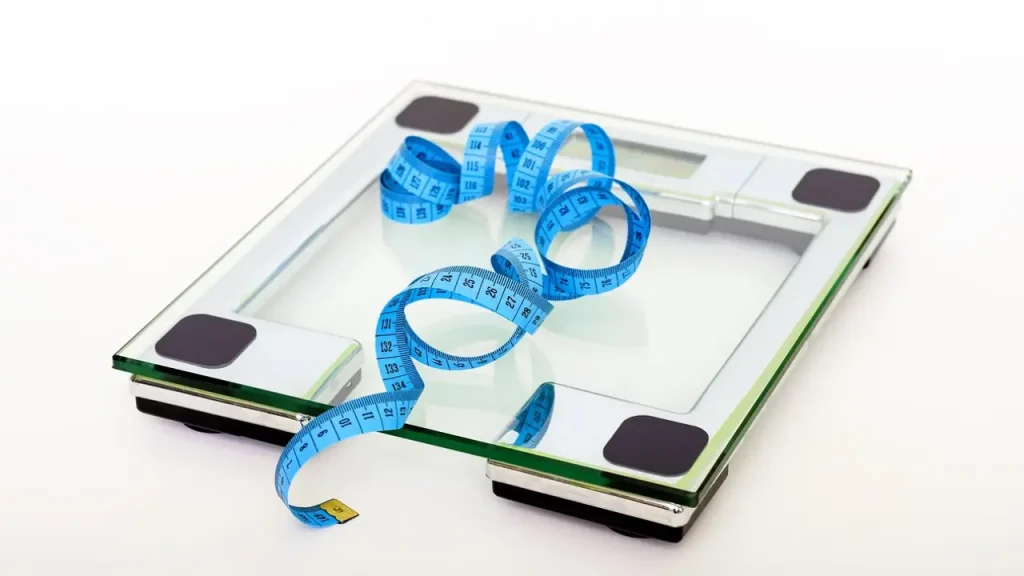
There is no single perfect answer.
Some people like weighing themselves every day because it gives them plenty of information and allows them to see normal fluctuations.
Others find daily weighing stressful and prefer once or twice a week.
NIDDK guidance for weight management programmes commonly recommends monitoring weight weekly, while other NIH guidance notes that daily weighing can help some people with weight management.
The important point is to choose a schedule that helps rather than harms you.
If daily weighing makes you anxious, step back.
If occasional weighing means you lose track of what is happening, weigh more consistently.
The best frequency is the one you can use calmly and consistently.
Use the Trend, Not the Daily Number
Suppose your weekly weigh-ins look like this:
Week 1: 207 lb
Week 2: 206 lb
Week 3: 206.5 lb
Week 4: 205 lb
Week 5: 204.5 lb
That is progress.
The fact that the number moved up slightly in week three doesn’t change the overall trend.
You could also use a rolling average if you weigh daily.
This can smooth out some of the normal fluctuations and make the long-term direction easier to see.
The reason to track your weight loss is not to react emotionally to every small movement.
It is to understand the pattern!
Weigh Yourself Under Similar Conditions
Consistency makes measurements more useful.
Try to weigh yourself under broadly similar conditions each time.
For example:
- at around the same time of day
- preferably after using the bathroom
- before eating
- using the same scales
- on the same type of floor
- wearing similar clothing, or no clothing
You don’t have to make this complicated.
You simply want to reduce unnecessary differences between measurements.
Measure Your Waist Too
For many people, the waist measurement is an extremely useful companion to body weight.
Why?
Because two people can lose the same amount of weight while seeing very different changes in body shape.
Your waist measurement can help show what is happening around your middle.
It can also be particularly useful if your main goal is reducing abdominal fat.
Measure consistently.
A practical approach is to measure around the waist at the same anatomical point each time and under similar conditions.
Don’t pull the tape tight enough to compress your skin.
You are looking for a repeatable measurement, not the smallest number you can manufacture.
How Often Should You Measure Your Waist?
There is no need to measure it every day.
Daily changes can be affected by food, digestion and water.
Once every few weeks is often enough to identify a genuine trend.
You could choose a specific day of the month and record:
Weight: 204 lb
Waist: 44.5 inches
Then repeat the same measurements under similar conditions.
Over several months, that gives you a much clearer picture than checking your waist every morning.
Take Progress Photos
Photographs can be surprisingly useful.
Changes in body shape happen gradually, and because you see yourself every day, they can be difficult to notice.
A photograph taken every few weeks can make those changes much easier to see.
You don’t need to share the photos with anyone.
They are for you.
For consistency, try to use:
- the same room
- similar lighting
- similar clothing
- the same camera position
- the same distance from the camera
- similar posture
You might take a front view and a side view.
If you are comfortable doing so, a back view can also be useful.
The goal is comparison, not vanity.
How Your Clothes Fit Can Be a Measurement
This is one of the simplest ways to notice progress.
Maybe your trousers fasten more easily.
Maybe a shirt that was tight now fits comfortably.
Maybe you need to tighten your belt.
These changes may happen even when the scales are moving slowly.
You don’t need a special measuring device.
Your wardrobe is already giving you feedback.
Track Your Fitness Too
Weight loss is not your only possible sign of improvement.
You may notice that:
- walking becomes easier
- you can walk for longer
- you recover more quickly after activity
- you can climb stairs more comfortably
- you can perform more repetitions
- you can use slightly heavier dumbbells
- your balance improves
- everyday tasks feel less tiring
These are meaningful changes.
Imagine that your weight has barely changed over a month but you can now walk twice as far and complete a strength workout that previously left you exhausted.
Would you really say that month was a failure?
Of course not.
Your fitness has improved.
Track Your Strength
Strength is particularly important as you get older.
During weight loss, maintaining muscle is valuable.
So record a few simple strength measures.
For example:
Chair stands: 8 repetitions
Band row: 12 repetitions
Dumbbell curl: 10 repetitions
The exact exercises will depend on your abilities.
What matters is having a few repeatable measures that you can compare over time.
Seeing strength improve can be highly motivating.
Track Your Daily Activity
Your exercise sessions are worth recording, but so is your everyday movement.
You might record:
- steps
- walking time
- cycling time
- swimming
- gardening
- household activity
- structured workouts
You don’t have to record every second of movement.
Choose measures that are useful to you.
For example:
Daily steps: 4,250
Walking: 25 minutes
Strength training: 20 minutes
Over time, you may notice connections between your activity and your other results.
Track Your Food Without Making Yourself Miserable
Food tracking can be useful.
It can help you discover:
- how much you are actually eating
- where your biggest calorie sources are
- how often you snack
- whether certain situations trigger overeating
- whether weekends are very different from weekdays
- whether drinks are contributing more calories than you realised
But food tracking does not need to become a full-time occupation.
You can use:
- a notebook
- a phone app
- a spreadsheet
- a simple daily checklist
The purpose is awareness.
It is not to create guilt.
A useful record might simply say:
Breakfast: yoghurt, fruit and oats
Lunch: chicken salad and wrap
Dinner: fish, potatoes and vegetables
Snack: small piece of chocolate
Drinks: water, coffee, one glass of wine
That’s already useful information.
Track Habits, Not Just Outcomes
This is one of the biggest improvements you can make to your tracking system.
Weight is an outcome.
Your daily habits are inputs.
You cannot directly control what the scales say tomorrow.
You can control whether you go for your planned walk.
You can control whether you prepare a healthy lunch.
You can control your portion size.
You can control whether you complete your strength session.
So track behaviours such as:
- vegetables with meals
- planned meals followed
- daily walking
- strength session completed
- water intake
- evening snacking
- sleep routine
- alcohol intake
When your weight stalls, you can then look at your habits rather than simply blaming your metabolism.
Create a Simple Weekly Scorecard
A weekly scorecard can make this much easier.
For example:
| Measure | This Week | Previous Week |
|---|---|---|
| Weight | 204.5 lb | 205.5 lb |
| Waist | 44.5 in | 45 in |
| Average steps | 4,800 | 4,200 |
| Walking | 5 days | 4 days |
| Strength sessions | 2 | 2 |
| Evening snacks | 3 | 5 |
| Energy | Better | Fair |
You can adapt the categories to suit your goals.
The important thing is that the tracker should help you understand your behaviour.
It should not become another source of stress.
Set Milestones Beyond a Target Weight
A goal such as:
“I want to lose 30 pounds.”
can feel very far away.
Create smaller milestones.
For example:
First milestone: complete two weeks of consistent healthy habits.
Second milestone: lose 5 pounds.
Third milestone: reduce waist measurement by 1 inch.
Fourth milestone: walk continuously for 30 minutes.
Fifth milestone: complete eight weeks of planned strength sessions.
Now you have multiple reasons to feel successful.
Track the Things You Can Control
This may be the most important principle in the entire article.
You can’t control exactly how much weight you lose each week.
You can control your behaviour.
You can control:
- how often you exercise
- what you buy at the supermarket
- how much you put on your plate
- whether you prepare meals at home
- whether you keep track of your habits
- how often you walk
- whether you complete your planned strength sessions
- whether you return to your normal routine after a setback
These are the actions that move the process forward.
Don’t Let Tracking Become Obsessive

Tracking is supposed to help you.
It is not supposed to take over your life.
If weighing yourself several times a day makes you anxious, stop.
If recording every calorie makes eating stressful, simplify your system.
If you become fixated on tiny changes in your waist measurement, measure less often.
The goal is useful information, not perfect control.
A healthy tracking system should leave you feeling more informed and more capable.
Not frightened of the scales.
What to Do When Progress Stalls
Eventually, almost everyone experiences a period when progress slows.
Don’t immediately assume that something has gone terribly wrong.
Look at the data.
Ask:
Has my average weight really stalled, or am I reacting to a few days of fluctuation?
Has my waist changed?
Has my activity changed?
Have my portions increased?
Have weekend meals become larger?
Am I snacking more?
Has my sleep changed?
Am I moving less during the day?
Tracking gives you something much more useful than a feeling.
It gives you clues.
Don’t Change Everything at Once
When progress slows, you may be tempted to overhaul your entire lifestyle.
That often creates unnecessary difficulty.
Instead, look for one or two areas that have drifted.
Perhaps you have stopped walking.
Perhaps your evening snacks have increased.
Perhaps your portions have gradually become larger.
Perhaps you’re drinking more alcohol.
Make a small correction and watch what happens.
Small adjustments are often easier to maintain than dramatic reactions.
Your Tracking System Should Evolve With You
When you’re starting out, keep it simple.
You might only track:
- weight
- waist
- walking
- strength sessions
Later, you may want to add food, sleep or other habits.
Or you may decide that some measures are no longer useful.
That’s fine.
Your tracking system is a tool.
It should adapt to your needs.
There is no prize for having the most complicated spreadsheet.
A Simple Monthly Progress Review
Once a month, take 15 minutes to review your progress.
Write down:
Current weight
Current waist measurement
Change since last month
Average activity
Strength improvements
Best habit you’ve developed
Biggest challenge
One thing to change next month
This creates a useful record of your journey.
Six months later, you will have something valuable: evidence of how your lifestyle has changed.
What Success Really Looks Like
Imagine two people.
Person A
Loses 5 pounds quickly, stops the diet and regains it.
Person B
Loses 5 pounds more slowly, improves their food choices, becomes more active, gets stronger and develops habits they can maintain.
Who has made the greater achievement?
The answer is obvious.
Weight loss is not a race to the smallest possible number.
It is an opportunity to build a healthier way of living.
That is why tracking habits and fitness can be as important as tracking weight.
Use Progress to Reward Yourself
Tracking should also help you recognise achievements.
Maybe you’ve completed a month of consistent exercise.
Maybe your waist is smaller.
Maybe you can walk farther.
Maybe your clothes fit better.
Maybe you’ve cooked at home more often.
These achievements are worth acknowledging.
And they don’t have to be rewarded with food.
That links naturally with How to Reward Yourself for Weight Loss Without Using Food, another article in our Weight Management series.
A Simple Tracking Template
You can use this as a starting point:
Weekly Weight-Loss Tracker
Week beginning: __________________
Weight: __________________
Waist: __________________
Average daily steps: __________________
Walking/cardio sessions: __________________
Strength sessions: __________________
Planned meals followed: __________________
Evening snacks: __________________
Sleep: __________________
Energy: __________________
What went well?
What could improve?
One goal for next week:
That’s enough.
You do not need a laboratory.
The Bottom Line
Tracking your weight loss can be extremely useful, but don’t reduce your entire journey to the number on the scales.
Track the trend.
Measure your waist.
Take occasional progress photos.
Notice how your clothes fit.
Record your activity.
Monitor your strength.
Track your habits.
And review your progress regularly.
Most importantly, use the information to make decisions rather than judgements.
A higher number this week is not a personal failure.
A slower week is not a reason to quit.
The purpose of tracking is to help you understand what is happening so that you can keep moving in the right direction.
Measure progress. Learn from it. Adjust when necessary. Keep going.
Frequently Asked Questions
How often should I weigh myself when trying to lose weight?
There is no single schedule that suits everyone. Weekly weighing is commonly recommended in weight-management programmes, while some people benefit from daily weighing. Choose the approach that gives you useful information without causing unnecessary stress.
Should I weigh myself every day?
You can, provided daily fluctuations do not upset you. Daily weighing can make trends easier to identify, but it is not essential.
How often should I measure my waist?
Every few weeks or once a month is usually enough to identify a trend. Measuring under similar conditions each time makes comparisons more useful.
Are progress photos really useful?
Yes. Body-shape changes can be difficult to notice when you see yourself every day. Consistent photographs taken several weeks apart can make gradual changes easier to see.
What should I track besides weight?
Useful measures include waist circumference, activity, strength, fitness, food habits, sleep, energy and how your clothes fit.
Why has my weight gone up even though I have been doing everything right?
Short-term changes can reflect water, food in your digestive system, salt intake, carbohydrate intake and other factors. Look at the longer-term trend rather than a single reading.
Should I track every calorie?
Not necessarily. Some people find detailed calorie tracking useful, while others prefer portion awareness and habit tracking. Use the level of detail that helps you without making eating stressful.
What if my weight stops going down?
Look at the trend first. Then review your portions, activity, snacks, drinks, sleep and other habits. A plateau is a reason to investigate, not a reason to panic.
What is the best way to track progress?
The best system is one you will actually use. A notebook, spreadsheet, app or simple weekly checklist can all work.
Should I track weight after I reach my goal?
Yes. Monitoring can help you notice if your weight begins to drift upwards and give you a chance to make small adjustments before a large regain occurs.
Suggested Further Reading:
- Why Sustainable Weight Loss Beats Short-Term Dieting
- 6 Weight Loss Tips That Actually Work
- Lose Weight Without Starving Yourself
- 7 Ways to Reduce Your Appetite
- How to Reward Yourself for Weight Loss Without Using Food
- Do You Need a Gym to Lose Weight?
- Can You Really Boost Your Metabolism to Lose Weight?
Medical Disclaimer
This article is for general educational purposes and is not a substitute for individual medical advice. If weighing yourself or tracking food becomes distressing, compulsive or associated with disordered eating, speak with an appropriate healthcare professional.