

There is an enormous amount of conflicting advice about exercise and fitness for older adults.
One article says walking is all you need. Another says you should lift weights. Someone else recommends high-intensity interval training (HIIT), while another insists that yoga, swimming or stretching is the answer.
So what should you actually believe?
The good news is that the evidence is considerably clearer than social media and fitness marketing often make it appear.
There is no single “best” exercise for older adults. The strongest approach is a combination of aerobic exercise, strength training, balance and functional movement, with mobility and flexibility playing an important supporting role.
The aim isn’t to become a professional athlete.
The aim is to maintain your strength, cardiovascular fitness, balance, mobility and independence for as long as possible.
What Does the Evidence Say About Exercise After 65?
The World Health Organization recommends that adults aged 65 and over aim for at least 150 minutes of moderate-intensity aerobic physical activity each week, or 75 minutes of vigorous activity, or an equivalent combination.
For additional health benefits, moderate activity can be increased to around 300 minutes per week.
Older adults should also perform muscle-strengthening activities involving the major muscle groups on at least two days per week. Where balance or mobility is a concern, WHO recommends regular multicomponent activity focusing on functional balance and strength, generally three or more days per week.
These recommendations are important because they reveal something that is often missed in fitness discussions:
Older adults don’t need one perfect exercise. They need a balanced fitness programme.
Walking: Is it Really the Best Exercise for Fitness in Older Adults?
Walking is an excellent form of exercise.
It is accessible, inexpensive, easy to control and can provide meaningful cardiovascular benefits. For many people who have been inactive, walking is probably the best place to begin.
It can also contribute to weight management and help people become more physically active in everyday life.
But there is a catch.
Walking alone does not provide enough resistance training to maintain all of the muscular strength that becomes increasingly important with age.
That matters because everyday independence depends on strength.
Getting out of a chair, climbing stairs, carrying shopping, getting into a car, recovering from a stumble and even maintaining good posture all require muscular strength.
So walking should be viewed as an important part of an exercise programme rather than the entire programme.
Verdict: Excellent — but incomplete on its own.
Strength Training: The Forgotten Essential in Fitness for Older Adults
If there is one part of fitness that older adults should take particularly seriously, it is strength training.
Strength naturally tends to decline with age, and maintaining muscle strength is closely connected with physical function and independence.
Resistance training can be performed with:
- Dumbbells
- Resistance bands
- Weight machines
- Body-weight exercises
- Cable machines
- Other forms of resistance
You do not have to join a gym.
Even relatively simple exercises can be valuable when they are performed consistently and progressed appropriately.
Useful examples include:
- Sit-to-stand exercises
- Squats or supported squats
- Wall push-ups
- Resistance-band rows
- Dumbbell presses
- Biceps curls
- Step-ups
- Hip-strengthening exercises
The important principle is progressive overload.
In simple terms, the muscles need to be challenged enough that they have a reason to adapt.
That doesn’t mean lifting enormous weights.
For an older beginner, the progression might simply be doing more repetitions, improving control, using a slightly heavier resistance band or moving from an assisted exercise to an unassisted version.
WHO recommends muscle-strengthening activities involving all major muscle groups on at least two days per week.
Verdict: Essential.
Balance Training: More Important Than Many People Realise
Balance tends to receive far less attention than cardiovascular fitness, yet it becomes increasingly important as we age.
A fall that might have been a minor inconvenience at 30 can have much more serious consequences later in life.
Balance training can include:
- Supported single-leg stands
- Heel-to-toe walking
- Controlled stepping
- Sideways stepping
- Direction changes
- Sit-to-stand exercises
- Tai chi
- Other functional balance exercises
Balance training also works particularly well when combined with strength training.
Strong legs are useful.
Being able to control those legs effectively is equally important.
WHO specifically recommends multicomponent physical activity emphasising functional balance and strength for older adults, particularly where mobility is limited or fall prevention is a priority.
Verdict: Essential for maintaining physical independence.
Cycling: Excellent Cardio Without High Impact
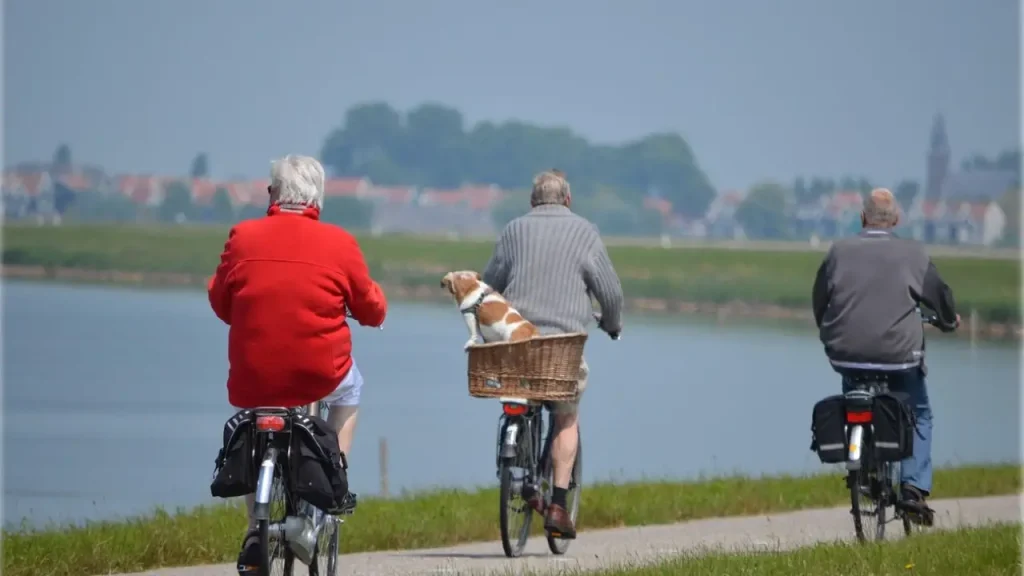
Cycling is an excellent cardiovascular exercise and can be especially useful for people who find walking uncomfortable.
An exercise bike has several advantages:
- It is low impact.
- Resistance can be adjusted.
- Intensity can be controlled.
- It can be used indoors.
- It provides a convenient way to accumulate aerobic exercise.
The main limitation is that cycling does not challenge standing balance very much and should not replace strength training.
A combination of cycling, resistance exercise and balance work can therefore be much more complete than cycling alone.
Verdict: Excellent cardiovascular exercise.
Swimming and Water Exercise
Swimming and water-based exercise can be particularly attractive for people who have difficulty with weight-bearing exercise.
The water provides support and reduces impact on the joints while still allowing substantial movement.
Water aerobics can also provide a useful cardiovascular workout.
Swimming, however, doesn’t completely replace resistance training or balance work.
A varied programme remains preferable.
Verdict: Very good, particularly when land-based exercise is uncomfortable.
What About HIIT for Older Adults?
High-intensity interval training has become one of the biggest trends in fitness.
HIIT involves alternating periods of relatively intense exercise with easier recovery periods.
Research shows that appropriately designed HIIT can improve cardiovascular fitness and other measures of physical health in older adults.
But that doesn’t mean every older person should be doing all-out intervals.
There is a huge difference between:
“HIIT can be beneficial”
and
“You need HIIT to get fit.”
You don’t.
For someone who is already reasonably fit and has no contraindications, appropriately prescribed higher-intensity exercise can be an excellent addition to a programme.
For someone who has been sedentary for years, has significant mobility limitations or has medical concerns, starting with aggressive HIIT is unlikely to be the smartest route.
WHO’s advice is clear that people who are inactive should start with small amounts and gradually increase duration, frequency and intensity.
Verdict: Potentially excellent, but not essential for everyone.
Stretching and Flexibility
Flexibility matters, particularly when stiffness begins to interfere with everyday movement.
Gentle stretching and mobility exercises can help maintain range of motion and complement strength and aerobic training.
But flexibility is sometimes given far too much importance.
Spending 30 minutes stretching while doing no meaningful strength or cardiovascular work isn’t a particularly effective overall fitness programme.
Think of mobility work as supporting the rest of your fitness, not replacing it.
Verdict: Valuable supporting work.
Yoga
Yoga can provide a useful combination of:
- Mobility
- Flexibility
- Balance
- Coordination
- Some muscular endurance
- Relaxation
The key is that different types of yoga provide very different physical demands.
Gentle forms can be particularly suitable for older beginners, while more demanding forms may provide a considerably stronger physical stimulus.
Yoga can be an excellent component of an overall programme, but there is no reason it has to be the only exercise you do.
Verdict: Very useful as part of a varied programme.
Fitness for Older Adults – Tai Chi
Tai chi is particularly interesting for older adults because it combines slow, controlled movement with balance, weight shifting, coordination and body awareness.
It is relatively low impact and can be modified for different ability levels.
Research also supports the role of multicomponent exercise, including activities such as tai chi, in helping maintain physical function in older adults. WHO recommends incorporating activities that improve balance and functional ability.
Verdict: An excellent option, particularly for balance and movement control.
Functional Training: Exercise That Has a Purpose
Functional training is simply training movements that resemble the things you actually need to do in everyday life.
Examples include:
- Standing up from a chair
- Climbing stairs
- Carrying shopping
- Reaching overhead
- Picking something up
- Stepping sideways
- Turning safely
- Getting up from the floor, where appropriate
This matters because the ultimate purpose of fitness in later life isn’t necessarily to run faster or lift heavier weights.
It is to remain capable.
The real goal is being able to say:
“I can still do the things I want and need to do.”
That is why strength, balance and functional movement deserve so much attention.
What About the 10,000-Step Target?
The famous 10,000-step target is often presented as though it were a universal requirement.
It isn’t.
There is no magical point at which 9,999 steps is inadequate and 10,000 suddenly becomes perfect.
Steps can be an extremely useful way of monitoring daily activity, but they are only one measure.
Someone could walk thousands of steps a day while doing almost no strength training.
Another person might walk less because of mobility limitations but perform an excellent combination of cycling, resistance training and balance exercise.
The quality and variety of activity matter.
WHO also emphasises that all physical activity counts, and that people should reduce sedentary behaviour and become more active according to their abilities.
Is More Exercise Always Better?
Not necessarily.
More activity can provide additional health benefits, but exercise also creates stress on the body.
Recovery matters.
For older adults in particular, a sensible training programme should balance:
Stimulus + recovery + progression.
Training hard every day isn’t automatically better than training intelligently several times per week.
A sustainable exercise programme that you continue for years is far more valuable than an extreme programme that lasts six weeks.
Should Older Adults Exercise Every Day?
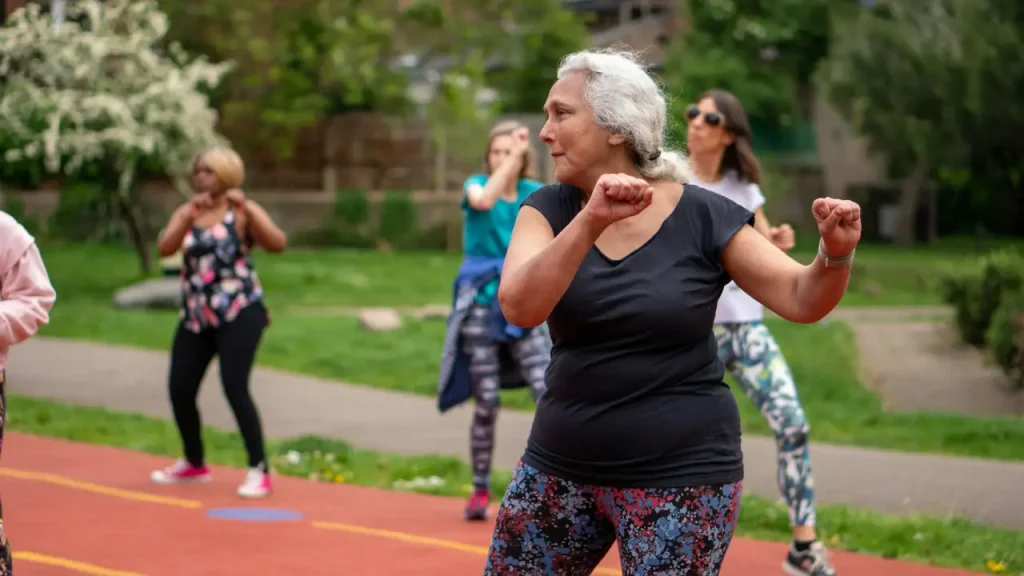
Daily movement is an excellent goal.
That doesn’t mean every day needs to involve a hard workout.
One day might involve resistance training.
Another might involve a brisk walk.
Another could include cycling and mobility work.
Balance exercises can be incorporated frequently, particularly when fall prevention is important.
It is also worth paying attention to what happens between workouts.
Someone who exercises for 30 minutes and then spends the remaining ten hours sitting has a very different overall activity pattern from someone who exercises for 30 minutes and also gets up frequently throughout the day.
WHO specifically recommends limiting sedentary behaviour and replacing sitting with movement whenever possible.
What Does Moderate-Intensity Exercise Actually Feel Like?
You don’t necessarily need an expensive heart-rate monitor to determine whether you’re exercising moderately.
A useful practical guide is the talk test.
During moderate-intensity exercise, you should be breathing more heavily than normal but still able to hold a conversation.
You would find it difficult to sing comfortably.
This provides a simple way to judge intensity without becoming obsessed with numbers.
Of course, people vary, so perceived exertion should always be interpreted within the context of an individual’s fitness and health.
The Biggest Exercise Myth About Getting Older
Perhaps the biggest misconception about Fitness for Older Adults:
“As you get older, you should take it easy.”
There is some truth hidden inside that statement, but it is very easy to misinterpret.
Older adults should not necessarily avoid challenge.
They should avoid inappropriate challenge.
The human body remains capable of adapting to exercise in later life.
The difference is that exercise should be matched to the person’s current ability and progressed gradually.
Someone who has been sedentary for years should not copy the exercise programme of a fit 30-year-old.
But neither should they assume that being older means they cannot become stronger, fitter and more capable.
The Best Fitness Programme for an Older Adult
The evidence points towards a simple formula.
Aerobic fitness
Aim towards 150–300 minutes of moderate activity per week, or an equivalent amount of vigorous activity, according to individual ability.
This could include:
- Walking
- Cycling
- Swimming
- Dancing
- Aerobic exercise
- Other activities that raise the heart rate
Strength and Fitness for Older Adults
Perform resistance exercise involving the major muscle groups at least twice per week.
Balance and functional movement
Include activities that challenge balance, coordination and functional strength regularly. For older adults with poor mobility, WHO specifically recommends this focus on three or more days per week.
Mobility and Fitness for Older Adults
Use regular mobility and flexibility work to maintain comfortable movement.
Daily movement
Break up long periods of sitting and look for opportunities to move throughout the day.
Progression
Start at an appropriate level and gradually increase the challenge.
This doesn’t need to happen quickly.
Fitness for Older Adults – So Which Exercise Is Best?
The answer depends on what you’re trying to improve.
For cardiovascular fitness: walking, cycling, swimming and other aerobic exercise.
For muscle and strength: resistance training.
For balance: balance exercises, tai chi and multicomponent training.
For mobility: mobility work, stretching and suitable forms of yoga.
For maintaining independence: strength + balance + functional movement.
For overall fitness: a combination of all of the above.
That last point is the most important.
There isn’t a competition between walking, cycling, weights, swimming, yoga and tai chi.
They each have different strengths.
The Ideal Approach: Train for Life, Not Just Fitness
A useful way to think about exercise after 65 is to stop asking:
“What is the best exercise?”
and instead ask:
“What physical abilities do I want to preserve?”
You probably want to be able to:
- Walk comfortably
- Get out of a chair
- Climb stairs
- Carry shopping
- Maintain your balance
- Get up safely if you stumble
- Travel
- Enjoy hobbies
- Remain independent
- Keep doing the things you enjoy
That requires more than cardiovascular fitness.
Fitness for older adults requires strength, endurance, balance, mobility and coordination.
And that is why the evidence increasingly supports a multicomponent approach.
Fitness for Older Adults – A Simple Weekly Model
A practical week might look something like this:
Monday: Strength training + short walk
Tuesday: Brisk walking or cycling + balance
Wednesday: Mobility + easy activity
Thursday: Strength training + walking
Friday: Cycling, swimming or brisk walking
Saturday: Strength or functional training + balance
Sunday: Easy walking and mobility
This is not a prescription and can be adapted considerably.
The point is the combination, not the exact schedule.
Fitness for Older Adults – The Bottom Line
You don’t need the latest fitness gadget.
You don’t need to run marathons.
You don’t need to reach 10,000 steps every day.
And you don’t necessarily need HIIT.
What you do need is a sensible combination of movement that challenges the cardiovascular system, maintains muscle, improves balance and preserves mobility.
For most older adults, the strongest foundation is:
Aerobic exercise + strength training + balance + functional movement + mobility.
Start at your current ability.
Progress gradually.
Remain consistent.
And remember one of the most important principles in exercise science:
Something is better than nothing — and the best programme is the one you can keep doing.
Fitness for Older Adults – A Final Safety Note
This article provides general educational information rather than an individual exercise prescription.
Anyone who has been inactive for a long period, has significant mobility or balance problems, has a chronic medical condition, or wants to begin vigorous exercise should consider discussing an appropriate exercise programme with a doctor or suitably qualified healthcare professional.
WHO specifically recommends that people who cannot meet the standard activity targets because of health conditions should be as active as their abilities and circumstances allow, with progression introduced gradually.
You may find our post: Why is Fitness Motivation so Difficult of interest.
Fitness for Older Adults – Sources
World Health Organization. WHO Guidelines on Physical Activity and Sedentary Behaviour.
World Health Organization. Physical Activity — Recommendations for Older Adults.