
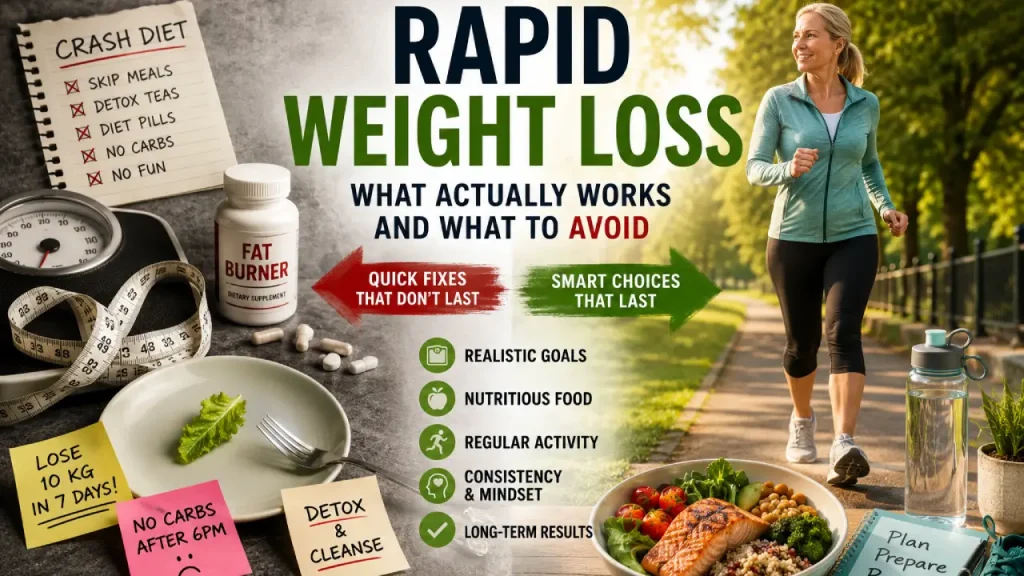
Can You Lose Weight Quickly Without Resorting to a Crash Diet?
The promise of rapid weight loss is everywhere.
Lose 10 pounds in a week. Burn fat while you sleep. Eat as much as you like and still lose weight. Take a pill and watch the pounds disappear.
It is understandable that these claims are attractive. When you want to lose weight, you want results – and you want them sooner rather than later.
But there is an important difference between losing weight quickly and losing weight safely and keeping it off.
For many people, a sensible target is around 1 to 2 pounds (0.5 to 1 kg) per week. That may not sound spectacular, but steady progress is more useful than a dramatic loss that is mostly water or is followed by rapid regain. The NHS recommends this general rate for people trying to lose weight. NHS
The real goal is not to find the most extreme diet you can tolerate.
It is to find the fastest approach you can follow consistently while still eating a nutritious diet and protecting your health.
What Actually Causes Weight Loss?
Let’s clear up one of the biggest sources of confusion.
Your body needs energy to function. You obtain that energy from food and drinks, while your body uses energy continuously for basic functions, movement and physical activity.
Over time, if you consistently take in less energy than your body uses, your body weight generally falls.
That does not mean that every calorie is nutritionally equal, nor does it mean that weight loss is simply a matter of willpower.
Food choices influence hunger, fullness, nutrition, enjoyment and how easy a plan is to follow. Physical activity affects health, fitness and energy expenditure. Sleep, stress, medications, medical conditions and your environment can also influence weight management.
That is why a good weight-loss plan is more than a list of foods you are supposedly allowed to eat.
The most effective approach is one that combines a moderate calorie deficit with nutritious food, appropriate activity and enough support to keep you moving forward. NIDDK describes successful programmes in broadly these terms: a healthy lower-calorie eating plan, physical activity when appropriate, guidance and support, and a plan for maintaining the weight loss. NIDDK
Weight loss is about more than simply eating less. Our article on Gut Health and Weight Loss looks at another important part of the picture.
I personally think, that going for Rapid Weight Loss is a complete waste of time because it isn’t sustainable!
So What Is the Fastest Sensible Way to Lose Weight?
The answer is surprisingly ordinary.
You don’t need a miracle ingredient.
You need to create a moderate, sustainable calorie deficit while making the food you eat as nutritious and filling as possible.
For many people, that means making several small changes at the same time rather than attempting one extreme change.
1. Reduce Calories Without Making Yourself Miserable
Weight loss requires an energy deficit, but that doesn’t mean you should try to eat as little as possible.
A plan that leaves you constantly hungry is difficult to maintain.
Instead, look for foods that give you plenty of nutrition and volume for relatively few calories:
- vegetables and salads
- fruit
- beans and lentils
- whole grains
- lean sources of protein
- plain or lower-sugar dairy products
- fish and seafood
- nuts and seeds in sensible portions
You can also reduce calories by paying attention to portions, cooking methods, sauces, sugary drinks, alcohol and highly processed snack foods.
You do not need to ban every food you enjoy.
A good plan should be something you can imagine continuing after you reach your initial goal.
A sustainable calorie deficit doesn’t mean starving yourself. See our guide to Lose Weight Without Starving Yourself for a practical look at eating less without making your diet miserable.
2. Make Protein and Fibre Work for You
Two of the most useful tools in a weight-loss diet are protein and fibre.
Protein is found in foods such as fish, poultry, eggs, dairy products, beans, lentils and other protein-rich foods. Fibre is abundant in vegetables, fruit, beans, pulses and whole grains.
Together, meals built around nutritious sources of protein and fibre can make it easier to feel satisfied while reducing your overall energy intake.
This is one reason a simple meal structure can work well:
Protein + vegetables or fruit + a sensible portion of a high-fibre carbohydrate or other nutrient-rich food.
The exact combination does not need to be perfect at every meal.
Consistency matters more than perfection.
3. Be Careful With Liquid Calories
One of the easiest ways to consume a surprising number of calories is through drinks.
Sugary soft drinks, sweetened coffees, large fruit drinks, milkshakes and alcoholic drinks can contribute substantial calories without making you feel as full as a solid meal.
Water is an excellent default drink.
That doesn’t mean you can never enjoy anything else. It means you should know what you are drinking and include those calories in the bigger picture.
Reading labels can also help. The NHS recommends paying attention to food labels and choosing healthier options where possible.
4. Get Moving — But Don’t Treat Exercise as Punishment
Exercise is important, but weight loss should not become a punishment programme.
You do not have to spend hours in a gym to benefit from becoming more active.
Walking, cycling, swimming, resistance training, gardening, dancing and many other activities can count.
The important thing is to choose activities that are appropriate for your health and ability and that you can do regularly.
The NHS recommends working towards around 150 minutes of physical activity a week, which can be divided into shorter sessions. NIDDK also notes that physical activity has important health benefits that are independent of weight loss and may help with maintaining weight loss.
And remember:
Exercise is not a licence to eat everything back.
Many people overestimate the number of calories they burn during exercise. Think of activity as part of your overall health strategy, not as a punishment for eating.
5. Stop Chasing the Perfect Diet

There are countless diets.
Low-carbohydrate diets. Low-fat diets. Intermittent fasting. Mediterranean-style eating. High-protein diets. Meal replacements. Time-restricted eating.
Some people do very well with one approach and struggle with another.
There isn’t a single diet that is automatically best for everyone.
A useful principle is this:
The best weight-loss diet is one that provides good nutrition, creates an appropriate calorie deficit and is realistic enough for you to follow over the long term.
NIDDK makes a similar point: different eating patterns can support weight loss, but the best choice is one that is backed by evidence and fits your health needs, preferences, culture and values well enough to maintain over time.
6. Set a Realistic Target
This is where many weight-loss attempts go wrong.
Someone decides they need to lose a large amount of weight and expects to do it in a few weeks.
When that doesn’t happen, they conclude that the diet has failed.
The problem may have been the expectation rather than the plan.
NIDDK identifies an initial goal of around 5% to 10% of starting body weight over six months as a realistic target for many adults.
For example, someone starting at 200 pounds would be looking at approximately 10 to 20 pounds as an initial target.
That might not sound like a spectacular transformation.
But a meaningful reduction in body weight can matter for health, and it gives you a much more realistic foundation for deciding what to do next.
What About Losing Weight Faster at the Beginning?
It is common to see the scale move more quickly during the first days or weeks of a new eating plan.
Don’t automatically assume that all of this represents body fat.
Changes in food intake, carbohydrate intake, sodium, hydration and the amount of food in the digestive system can all affect the number on the scale.
That is why the trend over several weeks is more informative than any single weigh-in.
A sudden drop can feel exciting.
A sudden increase can feel disastrous.
Neither necessarily tells you what happened to your body fat from one day to the next.
Look at the bigger picture.
Why Crash Diets Are So Tempting
Crash diets offer something sensible weight loss cannot promise:
instant gratification.
If you have been unhappy about your weight for years, the idea of fixing everything in two weeks is extremely appealing.
But extreme plans often come with equally extreme restrictions.
You may have to remove large groups of foods, dramatically cut calories, buy expensive products or follow a rigid set of rules.
Even when the scales fall, the bigger question remains:
Can you live this way for months and years?
If the answer is no, then the plan has not solved the long-term problem.
NIDDK specifically warns against weight-loss programmes that promise things such as losing weight without diet or exercise, eating unlimited favourite foods while losing weight, or losing 30 pounds in 30 days.
A promise that sounds too good to be true usually deserves a very hard look.
Weight Loss Red Flags: What Should You Avoid?
Be extremely cautious about any programme that makes dramatic promises.
Avoid programmes that promise:
- effortless weight loss
- huge losses in a matter of days
- permanent results without changing your habits
- fat loss from one specific part of your body
- a special food that supposedly melts fat
- detoxes that claim to remove years of toxins
- supplements presented as a replacement for a healthy diet
- testimonials instead of credible evidence
Before paying for a diet, app, supplement or programme, ask a simple question:
What evidence shows that this works for people like me, and how much weight do people actually lose and keep off?
NIDDK recommends checking whether programmes have been formally studied and whether the findings have been published in scientific journals.
What About Weight-Loss Pills and Surgery?
Not everyone needs to rely on lifestyle changes alone.
Weight-loss medicines and metabolic or bariatric surgery can be appropriate options for some people with overweight or obesity, depending on their health, weight and circumstances.
These are medical decisions, not shortcuts to be taken casually.
NIDDK notes that health professionals may use lifestyle changes alongside medicines or surgery when appropriate.
If you are considering medication or a medical weight-management programme, discuss the options with an appropriately qualified healthcare professional.
Don’t Ignore Your Waist Measurement
The scales are useful, but they are not the whole story.
Your weight can fluctuate from day to day, while changes in waist circumference can provide another useful measure of progress.
You may also notice changes in:
- how your clothes fit
- your walking ability
- your fitness
- your strength
- your energy
- your confidence
- your blood pressure or other health markers
This doesn’t mean the scale is irrelevant.
It means you should avoid allowing one number to determine whether you think you’re succeeding.
The Importance of Tracking Your Progress
You don’t need a complicated spreadsheet.
A simple record can be enough.
Track your weight regularly under reasonably similar conditions, and consider recording your waist measurement periodically.
You can also record habits such as:
- how often you exercised
- how many days you followed your eating plan
- how much sleep you generally got
- whether you ate when genuinely hungry
- how often you drank alcohol or sugary drinks
Tracking isn’t about judging yourself.
It is about learning what actually works for you.
NIDDK notes that successful programmes commonly include monitoring eating, drinking, sleep and physical activity, along with regular weight monitoring and ongoing support.
What If You Have a Bad Day?
You will.
Probably more than once.
You may eat too much at dinner. You may skip a workout. You may have a weekend that goes completely off plan.
None of those things means the whole attempt has failed.
The dangerous thought is:
“I’ve blown it, so I might as well give up.”
That turns one meal into one day, one day into one week and one week into another abandoned diet.
Instead, simply return to your normal plan at the next meal or the next opportunity.
Successful weight management isn’t about never making mistakes.
It’s about recovering from them without turning them into a permanent surrender.
A Simple Rapid Weight Loss Reality Check
Before starting any diet, ask yourself these seven questions:
1. Does it create a sensible calorie deficit?
If not, why would your weight fall?
2. Am I getting enough nutrition?
A smaller number on the scale isn’t worth compromising your nutritional needs.
3. Could I follow this for several months?
If the answer is no, it probably isn’t a sustainable strategy.
4. Does it include appropriate physical activity?
Movement matters for health and can help with maintaining weight loss.
5. Does it have a plan for what happens after I lose weight?
A diet that ends on the day you reach your target has ignored half the problem.
6. Is there credible evidence behind it?
Don’t confuse testimonials, celebrity endorsements or before-and-after photographs with good evidence.
7. Does it sound like a miracle?
If somebody promises extraordinary results with almost no effort, put your wallet firmly back in your pocket.
How Fast Should You Expect to Lose Weight?
For many adults, approximately 0.5 to 1 kg (1 to 2 pounds) per week is a reasonable general target.
Some weeks may be faster.
Some may be slower.
There may even be weeks when the scale doesn’t move at all.
That does not automatically mean that nothing is working.
Weight loss is not a perfectly straight line.
The NHS recommends aiming for around 1 to 2 pounds (0.5 to 1 kg) per week, while NIDDK emphasises realistic longer-term goals such as an initial 5% to 10% reduction over six months.
The objective is not to lose weight at the maximum possible speed.
It is to lose weight at a speed that allows you to continue.
When Should You Speak to a Healthcare Professional?
Before starting a significant weight-loss programme, it is sensible to seek professional advice if you have a medical condition, take medicines that may affect your weight or are considering a particularly restrictive diet.
It is especially important to get professional guidance if you have symptoms of an eating disorder or if weight loss is happening unintentionally.
You should also speak to a healthcare professional if you’re considering weight-loss medication, surgery or a medically supervised very-low-calorie programme.
A personalised plan may be much safer and more effective than trying to copy something you saw online.
The Bottom Line
There is a fastest way to lose weight.
But it isn’t a magic diet.
It isn’t a detox.
It isn’t a miracle pill.
And it isn’t starving yourself.
For most people, the fastest sensible approach is to create a manageable calorie deficit, eat nutritious and filling food, become appropriately active, monitor your progress and keep doing it long enough for the results to accumulate.
That sounds less exciting than the latest miracle diet.
It is also much more likely to work in the real world.
Don’t aim for the fastest possible weight loss. Aim for the fastest weight loss you can achieve without making your health and your future self pay the price.
For some simple habits you can start using immediately, see our guide to 6 Weight Loss Tips Anyone Can Use.
Frequently Asked Questions
Can I lose weight in one week?
You may see the number on the scale fall within a week, particularly when you first change your diet. However, a short-term change in body weight is not the same thing as losing a large amount of body fat.
Look at your progress over several weeks rather than judging the entire plan by one weigh-in.
Is rapid weight loss safe?
Very rapid weight loss can be inappropriate or unsafe, particularly when it involves severe calorie restriction or an unbalanced diet. For many people, a target of around 0.5 to 1 kg per week is a more sensible general guide.
Do I have to give up carbohydrates to lose weight?
No. Weight loss does not require everyone to eliminate carbohydrates. Different eating patterns can work, and the most useful plan is one that creates an appropriate calorie deficit while providing good nutrition and fitting your preferences well enough to maintain.
Do fat-burning foods really exist?
No individual food can magically override the overall energy balance that determines long-term weight change.
Some foods are more filling and nutritious than others, which can make a calorie-controlled diet easier to follow, but be suspicious of products claiming to “melt fat.”
Is skipping meals a good way to lose weight?
Some people use time-restricted eating or intermittent fasting successfully, while others find that skipping meals simply makes them overly hungry later.
The schedule matters less than whether the overall pattern helps you maintain an appropriate calorie intake and good nutrition.
How much exercise do I need?
The right amount depends on your health and ability. The NHS recommends working towards around 150 minutes of physical activity each week, which can be divided into shorter sessions.
What is a realistic first weight-loss goal?
For many adults, an initial goal of losing around 5% to 10% of starting body weight over six months is considered realistic.
What should I do after reaching my goal?
Don’t simply return to your previous habits.
Weight maintenance requires continuing many of the behaviours that helped you lose the weight. Ongoing physical activity, sensible eating and regular monitoring can all help reduce the risk of regaining weight.
One last thought before we conclude this article.
Most everybody becomes overweight over a long period of time (usually years) and yet they think going on a diet for a few weeks will make everything good again. REALLY?!
Further Reading
- NHS — Tips to help you lose weight
- NIDDK — Choosing a Safe & Successful Weight-loss Program
- NIDDK — Treatment for Overweight & Obesity
This article is for general educational information and is not a substitute for individual medical advice. If you have a medical condition, take medication, or are considering an intensive weight-loss programme, speak with an appropriate healthcare professional.