
A Clear, Evidence-Based Guide to the Fat You Can’t See.
Visceral fat has become one of the biggest topics in the weight-loss world.
Search online for “how to lose visceral fat” and you will find thousands of articles, videos, supplements and miracle programmes promising to burn it away.
Some of the advice is sensible. Some is exaggerated. Some is simply wrong.
You will be told that you need a particular breakfast, a special drink before bed, a certain fasting window, a supplement, a specific abdominal exercise or a “fat-burning” food.
That makes it difficult to know what to believe.
So let’s strip the subject back to what actually matters.
What is visceral fat?
Why does it matter?
How can you tell whether you have too much?
Can you reduce it without doing anything extreme?
And which of the claims circulating online should you ignore?
The short answer is encouraging:
Yes, visceral fat can be reduced.
You do not need a detox. You do not need a miracle supplement. You cannot crunch it away with hundreds of sit-ups. And you do not need to starve yourself.
The most reliable approach is built around sustainable changes to food intake, physical activity, body composition and overall health.
What Is Visceral Fat?
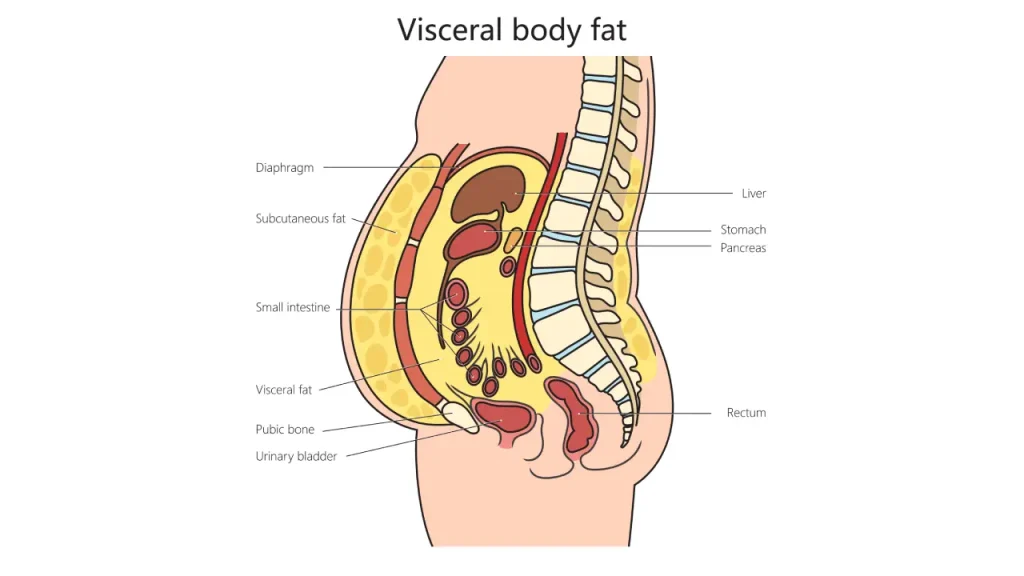
Visceral fat is fat stored inside the abdominal cavity, around internal organs.
It is different from the subcutaneous fat that lies directly underneath your skin.
The soft fat you can pinch around your stomach is mostly subcutaneous fat.
Visceral fat is deeper. You cannot simply grab it with your fingers.
It is important to understand that body fat is not just passive storage. Adipose tissue is biologically active and produces signalling molecules that influence metabolism, inflammation and other processes.
Visceral adipose tissue appears to be particularly important because excess accumulation is associated with a range of cardiometabolic problems.
That does not mean that all visceral fat is inherently bad. Some visceral fat is normal. The concern is excess accumulation.
Visceral Fat vs Subcutaneous Fat
This distinction causes a huge amount of confusion online.
Subcutaneous fat
This is the fat stored underneath the skin. You can usually pinch it. It contributes to the shape and softness of areas such as the abdomen, thighs, hips and arms.
Visceral fat
This is stored deeper inside the abdomen around internal organs. You cannot directly see or feel its exact amount from outside the body.
Both types of fat store energy, but they behave differently. Visceral fat is more strongly associated with metabolic risk than subcutaneous abdominal fat.
That is one reason two people with the same body weight can have different health-risk profiles.
Body weight tells you how much you weigh. It doesn’t tell you exactly where that weight is stored.
Why Does Visceral Fat Matter?
Excess visceral fat is associated with increased cardiometabolic risk.
Research has linked higher visceral adiposity with factors such as:
- insulin resistance
- type 2 diabetes
- high blood pressure
- unhealthy blood lipid levels
- cardiovascular disease
- fatty liver
- chronic low-grade inflammation
Visceral adipose tissue is metabolically active and can influence signalling pathways involved in inflammation, lipid metabolism and insulin sensitivity.
This is why abdominal fat distribution matters.
However, an important distinction needs to be made.
Having a larger waist does not mean that you can diagnose yourself with a dangerous amount of visceral fat from appearance alone.
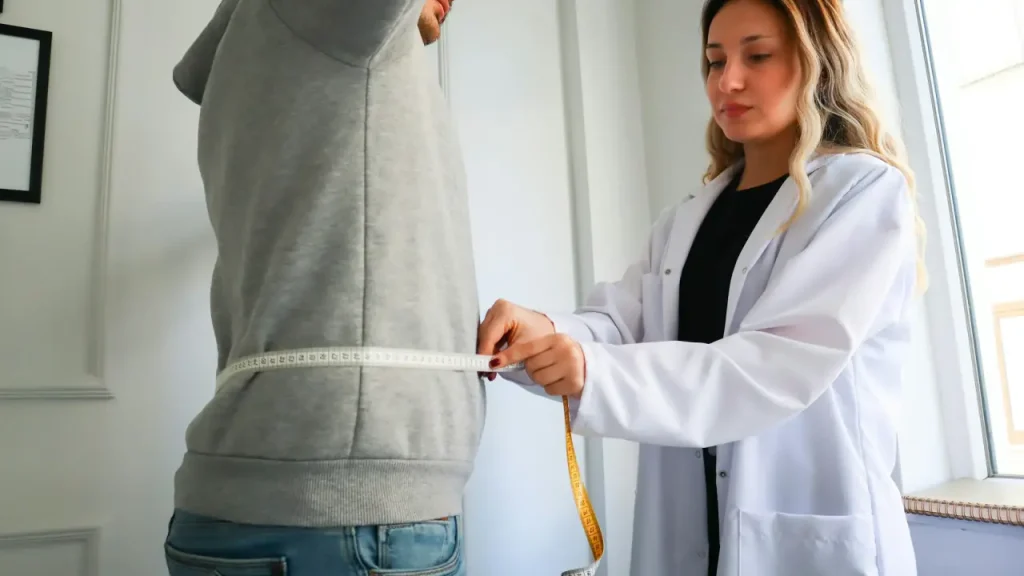
Waist circumference is useful as a practical marker of central adiposity and health risk. It is not a direct measurement of visceral fat.
Does a Big Belly Automatically Mean You Have a Lot of Visceral Fat?

Not necessarily.
The size and shape of an abdomen are influenced by several things:
- visceral fat
- subcutaneous fat
- posture
- muscle
- digestive contents
- bloating
- genetics
- body structure
Two people with the same waist measurement can have different amounts and distributions of visceral fat.
That is why you should be cautious about online claims that promise to calculate your visceral fat from a photograph.
A picture cannot tell you precisely how much visceral fat is inside your abdomen.
How Is Visceral Fat Actually Measured?
The most direct methods use imaging.
CT and MRI can distinguish visceral adipose tissue from subcutaneous fat and estimate its amount. These methods are used in research and, where clinically appropriate, in medical settings.
But they are not practical as routine home measurements for most people.
That is why clinicians commonly use simpler measures such as:
- waist circumference
- body weight
- BMI
- blood pressure
- blood glucose or HbA1c
- blood lipids
- other clinical information
These measures do not directly measure visceral fat. They help assess central adiposity and overall cardiometabolic risk.
That distinction matters.
What About Smart Scales That Give You a “Visceral Fat” Score?
This is one of the areas where I would be cautious.
Many home body-composition scales use bioelectrical impedance analysis to estimate body composition. Some then produce a number labelled “visceral fat”, “visceral fat level” or something similar.
These devices may be useful for tracking changes under consistent conditions.
But the number on the display should not be treated as though it were a CT scan.
Different devices use different algorithms. The estimates can be affected by hydration, food intake and other factors.
So if your smart scale tells you that your visceral-fat rating changed from 13 to 11, do not automatically assume that you have measured the exact amount of fat surrounding your organs.
Treat home estimates as approximate trends, not medical measurements.
Is Waist Circumference Useful?
Yes.
It is one of the simplest practical measurements of central adiposity.
A larger waist is associated with increased health risk, although the appropriate thresholds differ according to factors such as sex and ethnicity.
So beware of articles claiming that one waist measurement is the universal definition of “dangerous visceral fat.”
It isn’t that simple.
The useful approach is to measure consistently and consider waist circumference alongside other health information.
Can You Lose Visceral Fat Without Losing Weight?
This is an important question.
The answer appears to be yes, to some extent.
Exercise studies have found reductions in visceral fat even when changes in scale weight are relatively modest.
This is one reason that using weight alone to judge progress can be misleading.
You might become fitter, stronger and smaller around the waist without seeing a dramatic change on the scales.
Body-composition changes can occur alongside weight change.
That is another good reason to track:
- waist circumference
- body weight
- activity
- fitness
- strength
- how clothes fit
You do not have to choose between “weight matters” and “weight doesn’t matter.” Both are useful pieces of information.
What Actually Reduces Visceral Fat?
This is where the evidence becomes much less exciting than the internet would have you believe.
The most reliable strategies are ordinary ones:
Reduce excess energy intake when necessary.
Increase physical activity.
Preserve or build muscle with resistance training.
Improve the overall quality of your diet.
Reduce habits that contribute to excess calorie intake.
Get adequate sleep.
Manage alcohol sensibly.
Stay consistent.
There is no evidence that one magic food is responsible for most visceral-fat loss.
The body is more complicated than that.
Food and Visceral Fat
Do You Need a Special “Visceral Fat Diet”?
No.
There is no single recognised visceral-fat diet that everyone needs to follow.
Instead, focus on an eating pattern that helps you manage energy intake while providing good nutrition.
That usually means building meals around:
- vegetables
- fruit
- beans and lentils
- whole grains
- fish
- eggs
- lean meats or other protein sources
- nuts and seeds in sensible portions
- suitable dairy or alternatives
The details can vary.
There is no requirement to follow one fashionable eating style.
A Mediterranean-style pattern, a higher-protein pattern, a lower-carbohydrate pattern and other approaches can all potentially support weight management when they produce an appropriate energy intake and are nutritionally sound.
The best diet is often the one you can actually sustain.
Do Carbohydrates Cause Visceral Fat?
Carbohydrates themselves are not the enemy.
Fruit contains carbohydrate. Beans contain carbohydrate. Oats contain carbohydrate. Potatoes contain carbohydrate. Wholegrain foods contain carbohydrate.
The important question is not simply whether a food contains carbohydrates.
It is the overall dietary pattern, quantity, energy intake and nutritional quality.
Highly refined, calorie-dense foods can make it easier to consume more energy than you need.
That does not mean all carbohydrate-containing foods should be removed.
Does Sugar Cause Visceral Fat?
A high intake of added sugars can contribute to excessive calorie intake and may be associated with metabolic problems, particularly when sugary foods and drinks are consumed in excess.
But saying “sugar goes straight to visceral fat” is an oversimplification.
Your body does not have a single switch that converts every gram of sugar directly into abdominal visceral fat.
The bigger issue is the overall pattern.
Sugary drinks and highly palatable foods can make it very easy to consume more energy than you realise. Reducing them can therefore be a useful part of improving the diet.
Does Eating More Protein Help?
Protein can be useful during weight loss.
It contributes to the thermic effect of food, supports muscle maintenance and can help meals feel satisfying.
Good protein sources include:
- fish
- eggs
- poultry
- lean meat
- beans
- lentils
- yoghurt
- cottage cheese
- other suitable protein-rich foods
You do not need enormous quantities.
The goal is to include sensible portions regularly as part of a balanced diet.
What About Fibre?
Fibre-rich foods can be very useful for weight management.
Vegetables, fruit, beans, lentils, oats and wholegrain foods can help make meals more filling while contributing useful nutrients.
They can also make it easier to build a diet around minimally processed foods.
Again, fibre is not a magic visceral-fat burner. It is one component of a healthy eating pattern.
Exercise and Visceral Fat
Does Exercise Reduce Abdominal Fat?
Yes.
This is one of the strongest practical messages from the research.
Systematic reviews and meta-analyses of randomised trials have found that exercise reduces visceral fat in adults with overweight or obesity.
Importantly, the effect does not depend on one specific type of exercise.
Aerobic exercise, resistance training and combined approaches can all help.
Recent research has also found that higher exercise intensity can produce greater reductions in visceral fat in some populations.
That does not mean everyone needs high-intensity training.
The appropriate exercise programme depends on your age, fitness, health and physical ability.
Does Walking Reduce Visceral Fat?
Walking is absolutely worth including.
You do not need to run to reduce visceral fat.
Walking increases energy expenditure and can contribute to the activity levels required for long-term health and weight management.
If you are currently inactive, walking is also an excellent way to increase activity gradually.
Start with what you can manage.
Then build.
A daily walk that you actually perform is more useful than an “optimal” exercise plan that you never follow.
Does Strength Training Reduce Visceral Fat?
Yes.
Resistance training has been shown in systematic reviews to reduce visceral fat.
It also has another major advantage:
It helps preserve muscle during weight loss.
That is particularly important as you get older.
A successful weight-loss programme should ideally reduce excess fat without unnecessarily sacrificing strength and function.
Resistance training can include:
- dumbbells
- resistance bands
- bodyweight exercises
- weight machines
- other progressive resistance exercises
You do not need to lift enormous weights.
The resistance needs to be appropriate for you and progressively challenging.
What About HIIT?
High-intensity interval training has received a lot of attention.
Recent network meta-analyses suggest HIIT can be highly effective for reducing visceral adipose tissue.
That is interesting.
But it needs context.
Effective does not mean essential.
HIIT can be demanding.
For an older, unfit or previously sedentary person, immediately starting an intense interval programme may be inappropriate.
It may also increase the risk of injury or make exercise so unpleasant that the person gives up.
A moderate programme performed consistently can be an excellent starting point.
You can increase intensity later if your fitness and health make that appropriate.
What Is Better: Cardio or Weights?
You do not need to choose.
Both can play useful roles.
Aerobic exercise
Walking, cycling, swimming and similar activities can increase energy expenditure and improve cardiovascular fitness.
Resistance training
Strength training helps maintain or build muscle and can also reduce visceral fat.
Combined training
A combination can provide the advantages of both.
The best programme is usually the one that fits your circumstances and can be maintained.
Can Ab Exercises Burn Visceral Fat?
This is one of the most persistent myths online.
Crunches, sit-ups and abdominal exercises can strengthen the muscles of your abdomen.
They do not selectively melt the visceral fat surrounding your organs.
You cannot choose where your body removes fat first.
This is sometimes called “spot reduction.”
It is a seductive idea because the exercise is being performed on the stomach.
But exercising a muscle does not mean that the fat stored around that area is selectively removed.
Train your core because strong abdominal and trunk muscles are useful.
Don’t train it because you expect hundreds of crunches to burn away visceral fat specifically.
Fasting and Visceral Fat
Can Intermittent Fasting Reduce Visceral Fat?
Intermittent fasting and time-restricted eating can help some people lose weight.
Weight loss can, in turn, reduce visceral fat.
But fasting is not a special detox mechanism for visceral fat.
There is no evidence that you need a particular fasting window in order to “force” your body to attack visceral fat.
Some people find fasting convenient.
Others become extremely hungry and compensate later.
Still others simply prefer regular meals.
The useful question is:
Does this eating pattern help you maintain a sensible overall calorie intake and a nutritious diet?
If yes, it may be a workable approach.
If it makes your eating pattern miserable, it is not compulsory.
Does a 16:8 Fast Burn More Visceral Fat?
You will often see the claim that a 16:8 fasting schedule is specifically designed to target visceral fat.
That claim is too strong.
Time-restricted eating can be a useful weight-management strategy for some people, but it is not a magic visceral-fat switch.
The effects are likely to depend heavily on total energy intake, food quality, adherence and the individual.
There is no requirement to use a 16:8 schedule.
Lifestyle Factors
Can Poor Sleep Affect Visceral Fat?
Sleep is relevant to weight and metabolic health.
Poor sleep can influence appetite, food choices, energy and daily activity.
Chronic sleep problems may therefore make weight management more difficult.
That does not mean:
“Sleep eight hours and visceral fat disappears.”
It means sleep is one part of the larger system.
Improving sleep can make healthy eating and physical activity easier to maintain.
Does Alcohol Increase Visceral Fat?
Alcohol can contribute significant calories.
Regularly consuming more alcohol than intended can therefore make it harder to lose excess body fat.
The relationship between alcohol and abdominal fat is complicated and varies with drinking pattern, total energy intake and individual factors.
The sensible message is not that one glass of wine automatically creates visceral fat.
It is that regular excess alcohol can work against your weight-management goals.
If reducing visceral fat is a priority, reviewing how much and how often you drink is worth considering.
Visceral Fat and Ageing
Does Visceral Fat Increase With Age?
Body-fat distribution often changes with age.
Many adults tend to accumulate more abdominal fat and lose some lean mass as they get older, although there is considerable individual variation.
That makes resistance training, adequate nutrition and regular physical activity increasingly valuable.
Age is not a reason to give up.
It is a reason to focus on the things you can influence.
You may not be able to control every aspect of how your body changes with age.
You can influence your activity, nutrition, strength and body weight.
The Biggest Visceral Fat Myths
Myth 1: You Need a Detox
No.
Your body already has organs and systems that process substances and remove waste.
There is no evidence that a commercial detox programme is required to remove visceral fat.
Myth 2: You Need a Special Fat-Burning Food
No single food melts visceral fat.
Some foods are more nutritious, more filling or easier to include in a calorie-controlled diet.
That is useful.
It is not magic.
Myth 3: You Can Burn Visceral Fat With Abdominal Exercises
No.
Core exercises strengthen muscles. They do not selectively remove visceral fat.
Myth 4: You Must Stop Eating Carbs
No.
Carbohydrates can be part of a healthy diet.
The quality and quantity of your overall diet matter much more.
Myth 5: Fasting Is the Only Way to Lose Visceral Fat
No.
Visceral fat can be reduced through sustainable weight loss and physical activity without fasting.
Fasting is one possible eating pattern, not a requirement.
Myth 6: HIIT Is the Only Exercise That Works
No.
HIIT can be effective, but aerobic exercise, resistance training and combined training can also reduce visceral fat.
The most appropriate exercise depends on the person.
Myth 7: A Smart Scale Can Tell You Exactly How Much Visceral Fat You Have
Be cautious.
Home body-composition devices can provide estimates, but these are not equivalent to direct imaging of visceral fat.
Use the number as an approximate trend, not a medical diagnosis.
Myth 8: You Need to Lose a Huge Amount of Weight
Not necessarily.
Even modest reductions in body weight and waist circumference can be worthwhile for health.
And exercise may reduce visceral fat even when the scale changes less than expected.
Think in terms of meaningful improvement rather than perfection.
How Quickly Can You Reduce Visceral Fat?
This is another area where online claims become unrealistic.
You may see promises such as:
“Lose visceral fat in 7 days.”
“Burn dangerous belly fat in 14 days.”
“Destroy visceral fat in a month.”
Treat those claims with extreme caution.
Your rate of change depends on:
- starting body composition
- age
- sex
- calorie intake
- physical activity
- genetics
- sleep
- adherence
- medications
- medical conditions
Research shows that visceral fat can decrease with exercise and calorie restriction. It does not provide a universal countdown clock.
A better question is:
“Am I moving in the right direction over several months?”
That is a much more useful measure.
How Should You Track Your Progress?
You do not need a CT scan every few months.
For everyday weight management, a practical tracking system can include:
Body weight
Look at the trend rather than individual daily fluctuations.
Waist circumference
Measure under similar conditions at regular intervals.
Fitness
Record walking time, distance or other activities.
Strength
Track a few repeatable resistance exercises.
Habits
Record the behaviours that matter most to your plan.
Health measurements
Where appropriate, keep track of blood pressure, blood glucose, lipids and other clinical markers with your healthcare professional.
This approach gives you much more information than a single smart-scale number.
What Would a Sensible Visceral-Fat Reduction Plan Look Like?
A realistic plan could be remarkably simple.
Step 1: Improve the Food You Eat Most Often
Build most meals around nutritious foods.
Reduce the frequency of highly processed foods and excessive high-calorie snacks.
Don’t try to make your diet perfect overnight.
Step 2: Create an Appropriate Energy Deficit
If you need to lose weight, reduce energy intake enough to produce steady progress without resorting to extreme restriction.
Step 3: Walk More
Increase everyday movement.
Start at your current ability and gradually build.
Step 4: Add Strength Training
Use resistance bands, dumbbells, machines or bodyweight exercises as appropriate.
Step 5: Add Aerobic Exercise
Walking, cycling, swimming or another activity you enjoy can improve fitness and increase energy expenditure.
Step 6: Improve Sleep
Create a routine that supports adequate, consistent sleep.
Step 7: Review Alcohol
If alcohol consumption is contributing significant calories, reducing it may make weight management easier.
Step 8: Track Progress
Measure weight, waist and relevant habits without becoming obsessed with them.
Step 9: Be Patient
Judge the programme over months, not over three days.
Step 10: Adjust Rather Than Quit
If progress stalls, investigate the reason.
Change one or two things.
Then continue.
What About People Who Have a Large Amount of Visceral Fat?
If you have substantial abdominal obesity, particularly alongside high blood pressure, abnormal blood glucose, abnormal cholesterol or other risk factors, visceral fat should not be treated as a cosmetic problem.
It is worth discussing your overall cardiometabolic health with your doctor or another qualified healthcare professional.
Depending on your circumstances, they may assess:
- blood pressure
- blood glucose or HbA1c
- cholesterol and triglycerides
- liver health
- weight and waist circumference
- medications
- other cardiovascular risk factors
That information is much more useful than buying another supplement advertised as a “visceral fat burner.”
What If Your Weight Loss Is Slow?
Don’t assume the programme is failing.
Slow progress can still represent meaningful progress.
Your waist may be shrinking. Your fitness may be improving. Your strength may be increasing. Your habits may be becoming more consistent. Your health markers may improve.
And visceral fat may be changing even when the scale does not move dramatically.
This is why a broader definition of success is so useful.
The Important Difference Between Belly Fat and Fat Stored Around The Organs.
One final clarification is worth making.
People often use “belly fat” as though it means visceral fat.
It doesn’t.
Belly fat can include both:
Subcutaneous abdominal fat — fat underneath the skin.
Visceral abdominal fat — fat inside the abdominal cavity.
You can reduce your waist without knowing exactly how much of the change came from each depot.
The important thing is that reducing excess abdominal fat and improving your overall metabolic health are both worthwhile goals.
Don’t become obsessed with trying to identify an exact percentage of visceral fat from a photograph or a home scale.
The Bottom Line
Deep abdominal fat is real.
It matters.
And unlike many of the dramatic claims made online, the solution is not mysterious.
You do not need a detox.
You do not need a special tea.
You do not need a miracle supplement.
You do not need hundreds of abdominal exercises.
You do not need to eliminate carbohydrates.
And you do not need to punish yourself with extreme exercise.
What helps is much less glamorous:
Lose excess body fat gradually when necessary.
Move regularly.
Include aerobic activity.
Use resistance training.
Eat a nutritious diet.
Get enough protein and fibre.
Manage alcohol sensibly.
Prioritise sleep.
Track your progress.
Stay consistent.
The internet wants visceral fat to be a secret that requires a secret solution.
It isn’t.
The real challenge is not finding the magic trick.
It is building a way of eating and moving that you can still follow six months from now.
And that is good news.
Because you don’t need a miracle.
You need a plan that works in real life.
Frequently Asked Questions
Is visceral fat dangerous?
Excess visceral fat is associated with increased cardiometabolic risk, including insulin resistance, type 2 diabetes, cardiovascular disease and other metabolic problems. Risk depends on the overall clinical picture, not visceral fat alone.
How can I tell if I have visceral fat?
You cannot accurately determine the amount of visceral fat simply by looking at your stomach. Waist circumference can provide useful information about central adiposity, while CT and MRI can measure visceral fat more directly.
Can I have visceral fat even if I am not very overweight?
Yes. Body-fat distribution varies between individuals. Some people can have relatively high visceral fat despite not having a very high overall body weight.
Can you lose visceral fat without losing weight?
Some research suggests that exercise can reduce visceral fat even when scale weight changes relatively little. That is one reason to track waist circumference and fitness as well as body weight.
What exercise is best for visceral fat?
Aerobic exercise, resistance training, combined training and higher-intensity interval training can all reduce visceral fat. The best choice depends on your health, fitness and ability to exercise consistently.
Does walking reduce this type of fat?
Walking can contribute to visceral-fat reduction by increasing physical activity and supporting weight management. It is an excellent starting point for people who are currently inactive.
Does strength training reduce visceral fat?
Yes. Resistance training has been shown to reduce visceral fat and can also help preserve muscle during weight loss.
Does HIIT reduce visceral fat better than walking?
Some recent research suggests HIIT can produce larger reductions in visceral fat than moderate-intensity continuous exercise in certain populations. That does not mean HIIT is necessary or appropriate for everyone.
Does fasting burn this type of fat ?
Fasting can help some people reduce overall calorie intake and lose weight, which can reduce visceral fat. It is not a special detox mechanism and is not required.
Does sugar cause visceral fat?
A high intake of added sugars can contribute to excess calorie intake and poor diet quality, but sugar does not simply go directly to the visceral-fat compartment. Overall dietary intake matters.
Does alcohol cause deep abdominal fat?
Regularly consuming more alcohol than intended can add substantial calories and can make weight management harder. The relationship with visceral fat is influenced by overall drinking pattern and total energy intake.
Do detoxes remove visceral fat?
No reliable evidence supports commercial detox diets or cleanses as a special way to remove visceral fat. The body already has systems that process and remove waste.
Do visceral-fat supplements work?
Be very sceptical. Products marketed specifically as visceral-fat burners often make claims that go far beyond the evidence. Supplements can also interact with medicines and may not be appropriate for everyone.
How long does it take to lose excess abdominal fat?
There is no universal timeline. Results depend on starting point, diet, activity, health and consistency. Think in terms of steady change over weeks and months rather than dramatic results in a few days.
What is the fastest way to lose visceral adipose tissue?
There is no safe magic shortcut. A sustainable reduction in excess body fat combined with regular physical activity is a far more reliable approach than extreme diets or supplements.
Should I ask my doctor about the fat stored around my organs ?
It is sensible to discuss abdominal obesity and cardiometabolic risk with a healthcare professional, particularly if you have a large waist circumference or risk factors such as high blood pressure, abnormal blood glucose or abnormal cholesterol.
Suggested Further Reading:
- How to Track Your Weight Loss Progress: More Than Just the Scales
- Why Sustainable Weight Loss Beats Short-Term Dieting
- Can You Really Boost Your Metabolism to Lose Weight?
- Do You Need a Gym to Lose Weight?
- Lose Weight Without Starving Yourself
- 7 Ways to Reduce Your Appetite
- Late Night Eating: Will It Make Me Gain Weight?
- Can You Eat Junk Food and Still Lose Weight?
Medical Disclaimer
This article is for general educational purposes and is not a substitute for individual medical advice. If you have substantial abdominal obesity, high blood pressure, abnormal blood glucose, abnormal cholesterol, liver disease, cardiovascular disease, significant mobility limitations or another medical condition, discuss your weight-management plans with an appropriate healthcare professional. Do not begin an aggressive exercise, fasting or calorie-restriction programme without suitable advice.